
Electromagnetic Actuator Technology Column: From Basics to the Latest Trends
Column
Breaking Free from Compressor Dependence: Energy-Efficient Automation Achieved with Rotary Solenoids
2.Loss of compressed air hidden in sorting equipment
3.From Pneumatics to Electric Power — A New Drive Method for Sorting Mechanisms
1. Introduction
In recent years, labor shortages and rising shipment volumes have accelerated the adoption of automated sorting devices and conveyor systems across the logistics, agriculture, and manufacturing sectors.
At the same time, lowering equipment power consumption has become an important priority for companies working toward carbon neutrality and CO₂ emission reductions.
It is estimated that air compressors account for 20–30% of power consumption in factory facilities. Given this, reducing compressor operating rates is an effective energy-saving strategy, prompting growing interest in replacing pneumatic actuators (air cylinders) with electric actuators in production equipment.
2. Loss of compressed air hidden in sorting equipment
Automated equipment commonly employs many air cylinders. However, compressed-air-powered systems suffer from several structural energy losses.
- Compression losses and heat generation in compressors
- Air leaks from piping and fittings
- Excess supply due to pressure control
- Energy lost during exhaust after operation
As a result, only less than 10% of the input power to compressors is effectively used to drive the cylinders. This substantial inefficiency has become a major barrier to advancing carbon neutrality on manufacturing floors.
3. From Pneumatics to Electric Power — A New Drive Method for Sorting Mechanisms
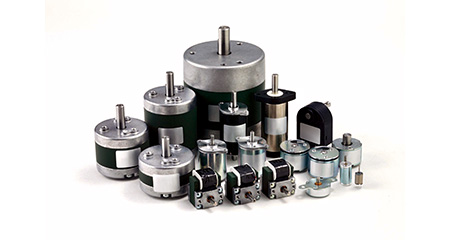
Transitioning to electric actuators is receiving increasing attention as a promising solution to this issue. In particular, rotary solenoids are gaining traction for applications that require short strokes and rapid response, including slide shooters, lane-switching mechanisms, stoppers, and gate operations.
Bistable rotary solenoids are ultra-low-power actuators that feature zero standby power consumption. They self-hold in position via permanent magnet force and only consume energy during actuation.
4.Rotary Solenoid (Electric) vs. Air Cylinder (Pneumatic)
| Heading | Rotary Solenoid (Electric)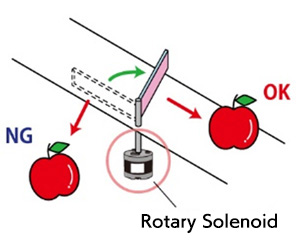 |
Air Cylinder (Pneumatic)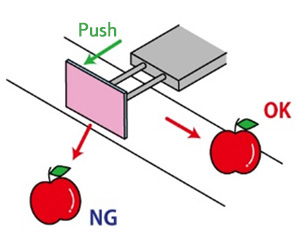 |
|---|---|---|
| Figure: Image of a high-speed, high-frequency defective-product rejection mechanism using a rotary solenoid | ||
| High responsiveness | ◎ Operates at millisecond-level precision, ideal for high-frequency sorting. |
△ Response delay due to air compression and flow path effects. |
| Compactness | ◎ compact structure that is easy to miniaturize |
△ Including valves and piping, it tends to become larger |
| Output force (torque / thrust) |
△ △Suitable for medium (size-dependent) short-stroke, small- to medium-torque applications. |
◎ High output is easily achieved Suitable for high thrust and long stroke |
| Energy savings | ◎ Power is supplied only during operation, with zero standby power |
× Continuous compressor operation results in high energy consumption |
| Total equipment power consumption | ◎ Low (individual drive) |
× High (dominated by compressor load) |
| Maintainability | ◎ Essentially maintenance-free (bearing models have a proven durability exceeding 100 million cycles) |
△ Air leak inspection, filter replacement, and compressor maintenance are required. |
| Cleanliness and quietness | ◎ Exhaust-free and low-noise, suitable for clean environments. |
△ Exhaust noise and air-blow noise, raising concerns about particle dispersion. |
| Suitability for low-temperature environment | ◎ Stable operation even in refrigerated and frozen environments. |
△ Susceptible to condensation and freezing. |
| Wiring and piping | ◎ Requires only power wiring. |
× Air piping, valves, and regulators are required. |
| Initial installation cost | △ Unit cost is somewhat high |
◎ The equipment alone is inexpensive. |
| Operating cost | ◎ Low (power only) |
× High (electricity and compressor maintenance costs) |
5. Application Examples
By replacing the sorting and diverter mechanisms that previously used air cylinders in logistics and production lines with “Bistable Rotary Solenoids,” compressor power consumption can be dramatically reduced. In addition, this substitution provides the following concrete benefits in automation equipment across many industries.
Logistics sorting (switching the slide-shoe track angle)
In a slide-shoe sorter that diverts parcels on a high-speed conveyor, operations must be instantaneous, precise, and continuous. The rotary solenoid’s quick rotational motion and high repeatability make it ideal for driving the shoes, while eliminating the need for air piping contributes to a more compact system footprint.
Automatic sorting and discharge (conveyor route switching)
They are employed in automatic sorting machines that swiftly assess product quality and size, as well as in reject ejectors that eliminate defective items. Boasting high durability that withstands prolonged continuous operation, they significantly reduce maintenance work such as air-leak inspections.
Route allocation for an automated transport system (guidance for lane branching).
It is ideal for track-switching applications in overhead sorters, linear ceiling transport systems, and monorail transport systems (OHT) used in factories and warehouses. By eliminating the need for pneumatic equipment such as compressors and valves, it reduces the overall weight of the transport system and increases design flexibility.
Paper sorting (flap switching mechanism)
It is also ideal for devices that rapidly sort paper of various thicknesses, such as ATMs (cash dispensers), postal sorting machines, and document sorter-readers. Because there is no pneumatic response delay, it can reliably switch transport paths within the limited space of the equipment with millisecond-level responsiveness.
By replacing it with a rotary solenoid, not only is the power consumed by the compressor reduced, but it also directly contributes to faster and more precise operation, space savings, and reduced maintenance workload, powerfully supporting the construction of next-generation smart systems.
The special page presents illustrated examples of the mechanisms described above and recommends solenoid products for each application. Please review the cases that most closely match your design requirements.
6. Conclusion
In manufacturing and logistics environments, the shift toward electrification for carbon neutrality is accelerating, and automated sorting equipment is rapidly evolving into “air-free” smart drive systems. At the heart of this evolution is the rotary solenoid — an actuator that delivers pneumatic-level response speed combined with the superior controllability and high energy efficiency of electric power. By adopting rotary solenoids, companies can realize next-generation sorting systems that are highly efficient, reliable, and capable of significantly minimizing energy loss.
