
Electromagnetic Actuator Technology Column: From Basics to the Latest Trends
Column
Comprehensive Guide to Latching Solenoids! Energy-Saving & High-Reliability Lock Mechanism Achieved with Permanent Magnets ( Rare-earth free ).
2.What is a latching solenoid?
3.Why is an external resistor necessary?
1.Introduction
This column explains the basic mechanism, features, structure, and applications of latching solenoids, along with an introduction to the external resistance required when using them.
2.What is a latching solenoid?
①Mechanism and Features
A latching solenoid is a type of linear solenoid that attracts its shaft using a direct current power source. Its most notable feature is its self-holding capability, whereby the shaft remains in place due to the magnetic force of an internally embedded permanent magnet, even after power to the coil is terminated. This eliminates the need to continuously supply current for position holding, thereby achieving significant energy savings.
*This product's permanent magnets do not contain any rare earth materials.
②Structure
As a general structure, it consists of a coil, a shaft, and a permanent magnet. When current flows through the coil, a magnetic field is generated, causing the shaft to be attracted and move to the designated position. Even after the current is stopped, the position is maintained by the magnetic force of the permanent magnet. When current is applied in the reverse direction, the holding is released, enabling the next operation.
- Before operation, it is held in position A of the diagram by the magnetic field of the permanent magnet.
- When electricity is applied, a magnetic field is generated in the coil as shown in Figure B, causing the shaft to move from right to left.
- After operation, it is held in position C due to the magnetic field of the permanent magnet.
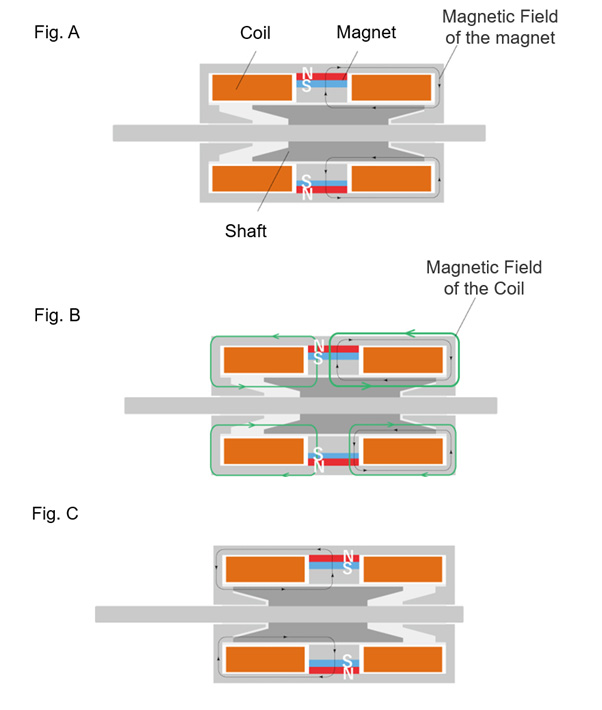
Latching solenoid structural diagram
③Comparison with Solenoid
| Solenoid | Latching solenoid | |
|---|---|---|
| Video | ||
| Current waveform | 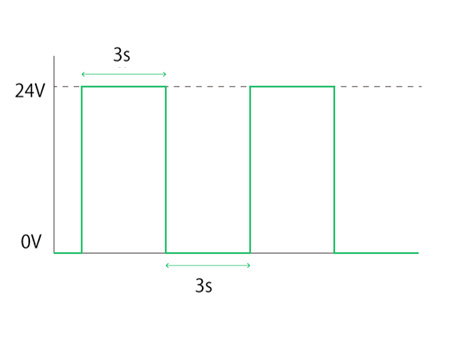 |
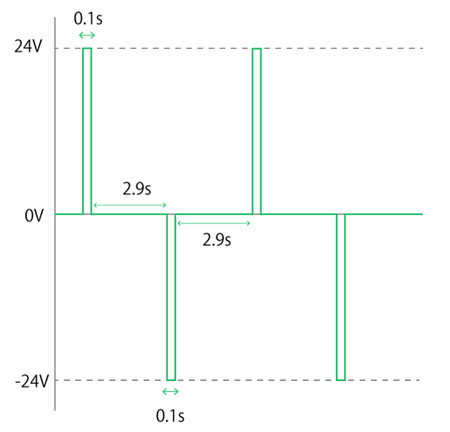 |
| Retention | Continuous power supply is required for retention | The permanent magnet allows position retention even in an unpowered state. |
| Power consumption | Power consumption is high, and it also generates heat. | Low power consumption and low heat generation |
3.Why is an external resistor necessary?
①Reasons why external resistance is necessary
The latching solenoid holds the shaft position using a permanent magnet. To transition to the next operation by releasing this holding state, a "demagnetizing current" must be flowed in the reverse direction to cancel out the magnetic force of the permanent magnet.
External resistance plays an important role in generating this demagnetizing current.
As shown in the diagram below, when current flows, after passing through the attraction coil, the circuit splits into the demagnetizing coil and external resistance, forming a parallel circuit. Therefore, it is possible to adjust the magnitude of the demagnetizing current in the coil by varying the external resistance value.
The external resistance described in the catalog is designed at a value where the holding force of the permanent magnet and the force of the demagnetizing coil are precisely balanced against each other.
There are solenoids that can operate without external resistance, but care must be taken as they may not meet their intended attraction force. Please consult us if external resistance cannot be used.
②Regarding the drive circuit and its operation
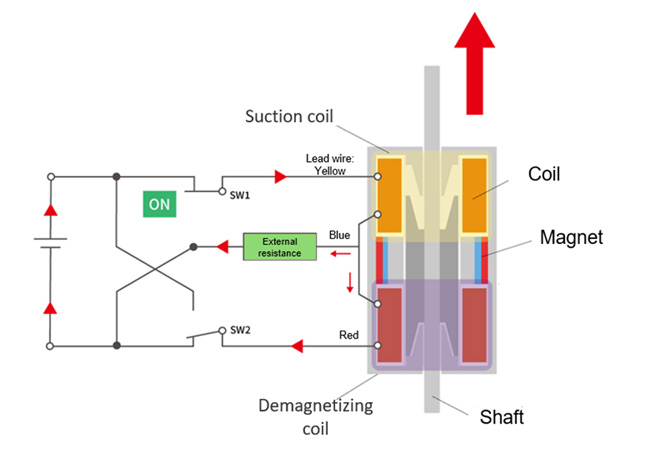
【When moving from bottom to top】
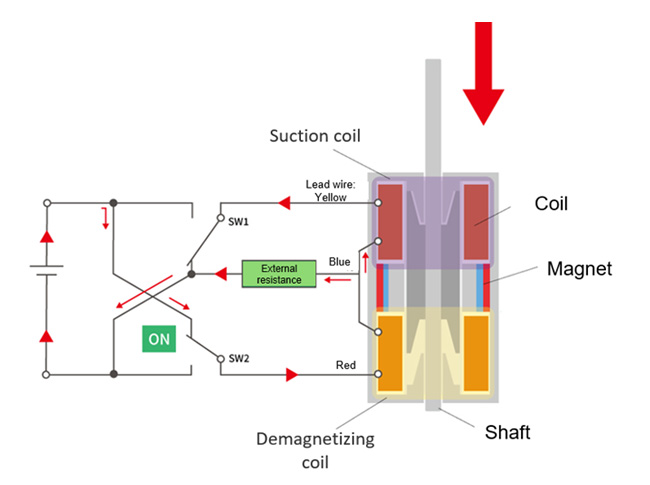
【When moving from top to bottom】
4.Examples of Applications
The "non-powered self-holding" feature of the latching solenoid is ideal for lock mechanisms that require maintaining a locked state for an extended period or ensuring safety during power outages by retaining position even when the power is off.
Electric lock operation
- Medical and analytical equipment: Contributes to preventing malfunctions and improving safety.
- Lockers: Excellent in reducing power consumption and ensuring security during power outages.
5.Summary
This time, we explained the mechanism, features, structure, and applications of the latching solenoid, and introduced the external resistance required for use. It is an ideal product for improving system safety and achieving energy efficiency.
Furthermore, Takano Corporation accommodates special specifications, including:
- Waterproof design
- Noise-reduction design utilizing rubber or air dampers
- High suction power specification exceeding 40N
If you have any questions or require further information, please feel free to contact us.
